Issue Six is now available digitally for free or $25 for a printed version.
Artists in issue six
Robert Gorchov *Cover Artist
Robert Frankel
Kevin Kemp
Dio D’Brutto
Valentina Fedoseeva
Ernest Compta
Matthew Clarke
RINA Taytu
Nicklas Farrantello
Sven Froekjaer-Jensen
Mitchell Pluto
Richard Reynolds
Gale Rothstein
Thelma Van Rensburg
Jennifer Levine
Susan Spangenberg
Emmanuel Laveau
Samia Farah
Selkie Quan
Bux Dhyne
Bill Skrips
Poete Maudit
Christy Carter
BILL _L47
Sophie Jacobs
Oshi Artist
Michael Chomick
David Sheskin
William Francis
Richard Green
Hermine Harman
Recently, at a traveling carnival, I came across one of those old coin-operated fortune-telling machines. You put a quarter in the slot, a figure comes to life, waves its “hand” over a glass ball, and out pops a scroll of paper with your future written on it. I was struck by the device’s mannequin, wrapped in colorful, patterned, silks and the device’s antique carved wood cabinet, with brass detailing. I was also intrigued by the idea that this mechanical device with gears and cogs was somehow supposed to be able to tell me my future. How could a cold machine possibly know my life’s destiny? Of course, it can’t. Like the fortune cookie or the Magic 8 Ball, these things are meant solely for entertainment.
Yet, they still hold power over us. For some people, a Ouija board or a deck of tarot cards can be the couriers of life-changing information. These objects are believed to possess mystifying and arcane knowledge, even though, in reality, they are just novelty consumer products. The clerk at the magic store orders a gross of tarot cards whenever the stock is low and a new Ouija board can be purchased in the board game section of your local toy store, next to Chutes and Ladders.
The thing that makes these items magical can be found in their construct…not in just how they are made or their graphic design, but in their entire idea. Usually, the stories around these items are just as important as the items themselves; and the contexts in which they are used play a massive part in their power.
I began to wonder if there are other objects that somehow provide knowledge through purely mechanical means. Old analog calculators leaped to mind, the slide ruler, the abacus, and the mechanical adding machine with its crank handle. These devices also convey complicated ideas through the simple arrangement of moving parts. And their power is not questioned. All of ancient China was controlled using sliding beads on an abacus.
Like the fortune-telling machine at the fair, these tools of science were often also beautiful, delicately carved devices with inlaid brass and ivory. Although these machines were based on math, for some, they too possess mystifying and arcane knowledge. They have their own mysticism, their own sacred places of use, and their own histories and lore. In the hands of mystics at NASA, the slide ruler took us to the moon.
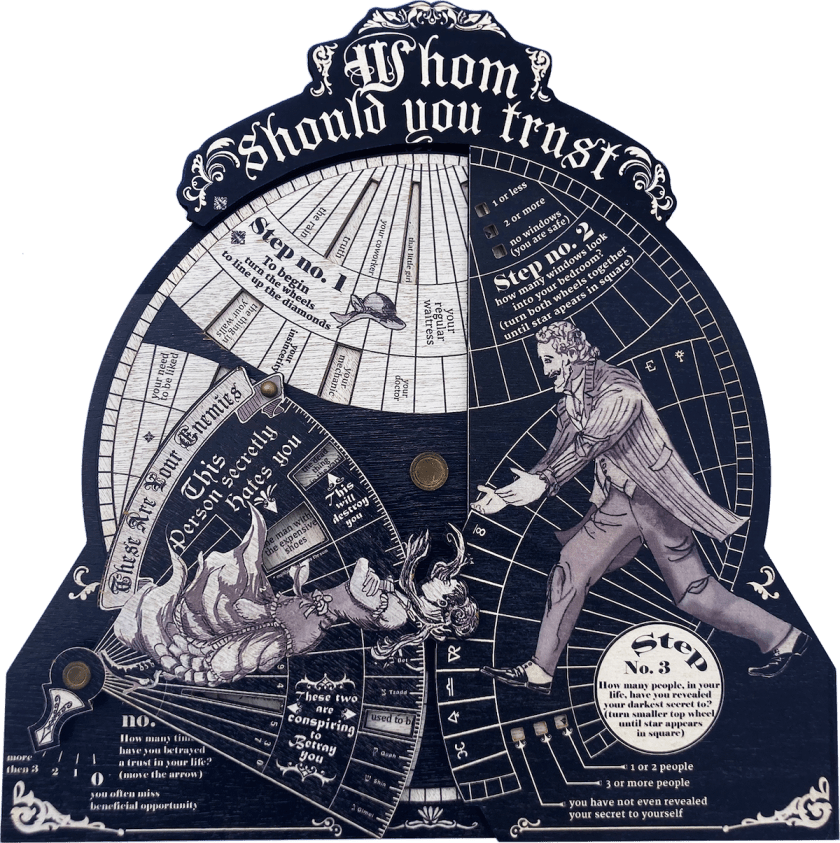
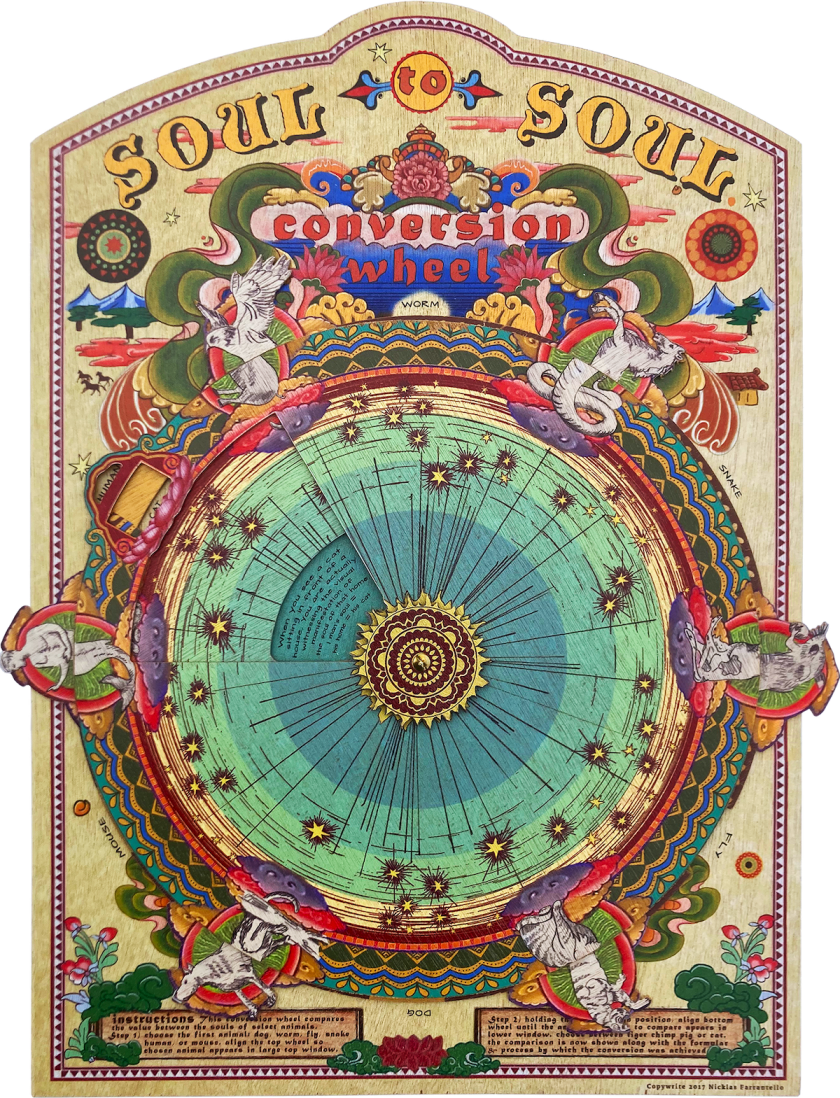
So here I present a new paradigm. What if science made devices that could calculate more than just numbers? What if engineers and mathematicians could come up with formulas and conversion wheels that could tell us who to love or the nature of the soul? What might it look like if all the mysteries of the world could be quantified, laid out in charts, then formatted into easy-to-use slide wheels? What if there was a company that had been creating just such devices for decades? This collection is a celebration of that idea
Whom Should You Trust | mixed | 16″ x 16″ x .75″What They Made You Forget | mixed | 20″ x 30″ x 1″How Many Cat Souls Equals One Dog Soul | mixed | 30″ x 20.75″ x 1″Is Your Relative Possessed | mixed | 20″ x 23″ x 1″
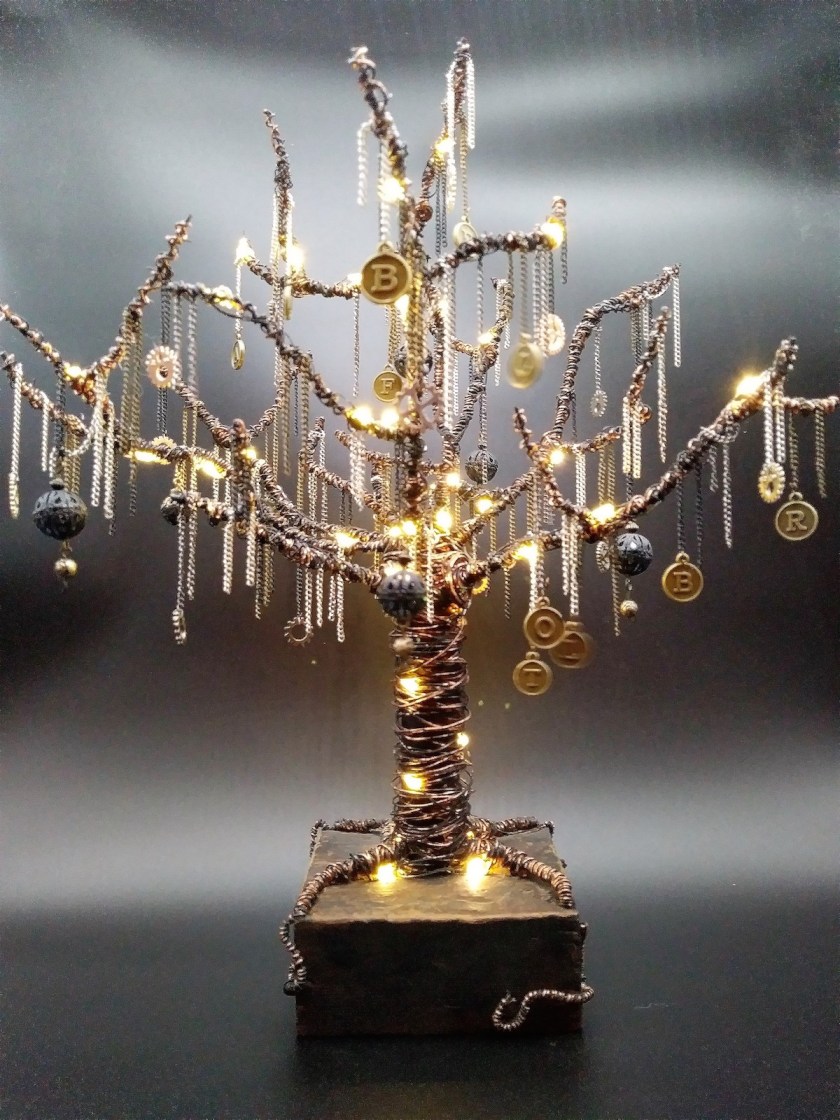
Working with old vintage items and broken items is a thrill. Taking something discarded and giving them a new life is my passion as an Artist.
Down the rabbit hole | mixed media sculpture | 13in H x 7.5 in L x 4in WWoodlyn fairly on a toadstool | Mixed media sculpture | 10in H x 6.5in L x 4in WFantasy Flowers | Mixed media sculpture | 14in H x 5in L x 4in WFamily tree | Mixed media sculpture | 13in H x 11in L x 9in W
The theme of my works is coming from “To Live”. Most of them, if anything, are based on “sorrow” and “trouble” around us. Among these sorrow things, I shift my thought to feel a thanks. When I feel a thank, I see a small “dream” near in the future. It is “drawing” for me to make a form from a small dream.
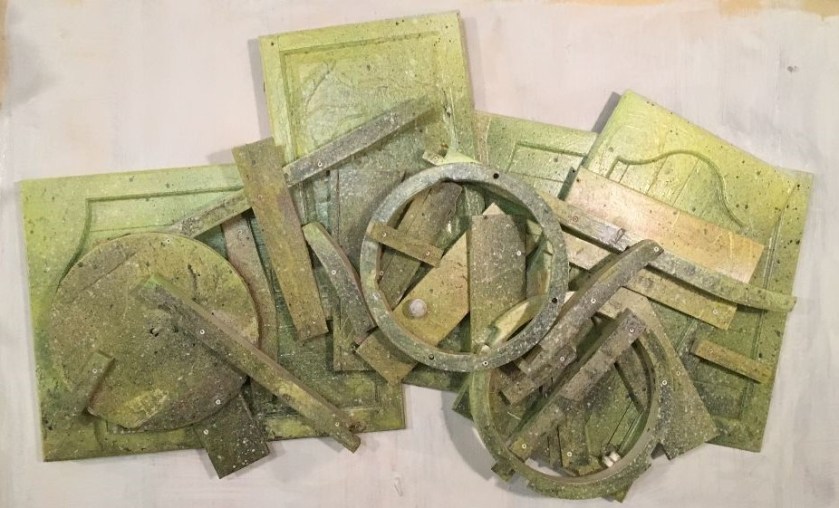
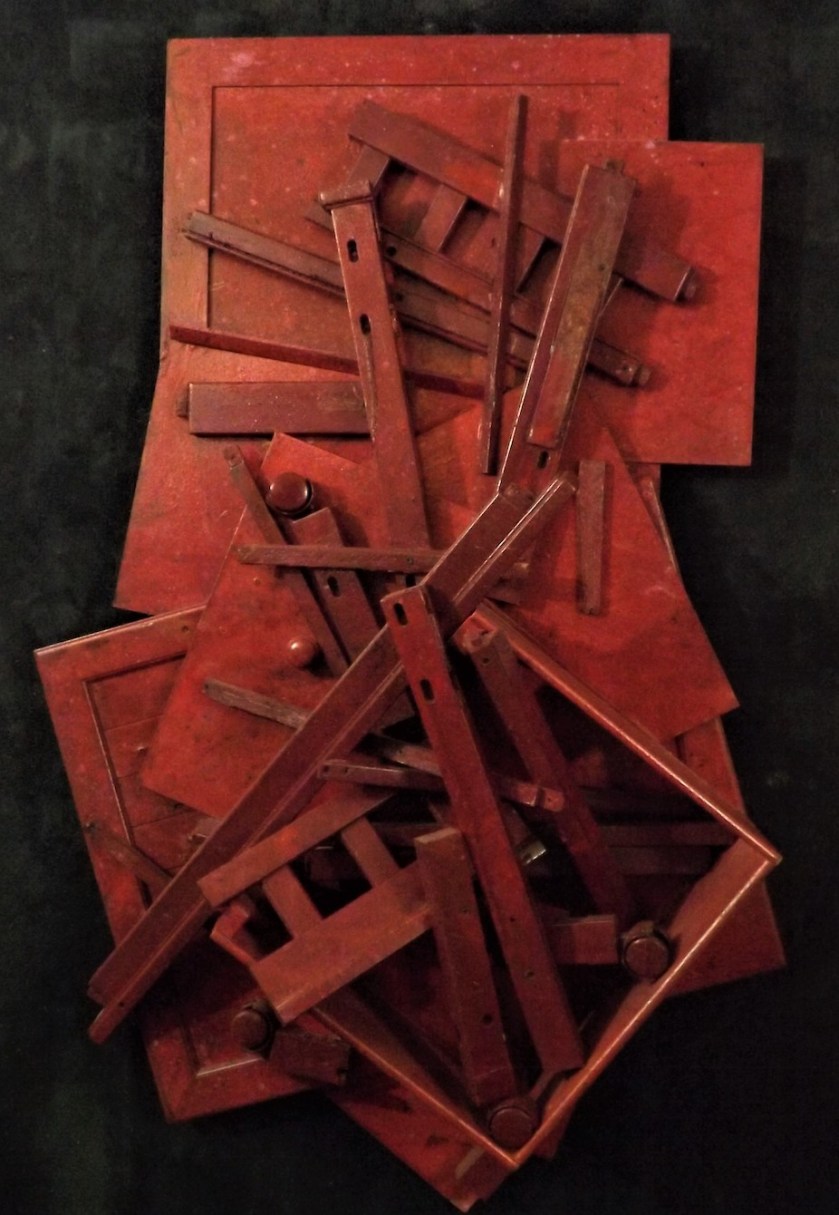
I spend a lot of time watching paint dry which is fine because I consider myself to be, first and foremost, a painter. Experiments in drawing led me to tear paper and arrange found objects, lifting me off the paint surface into collage and assemblage. The arrival of furniture ‘shards’ seemed a natural extension of this process and allowed me to step outside the bounds of academic art. Recovered from alleys and yard sales, the chairs, tables and dressers introduce a human element to, otherwise, complex gestures. They represent a human scale with human references: arms, feet, legs, backs, seats and so on. An anthropomorphic whisper keens behind the work.
During a year spent teaching in Japan, I visited ancient Kyoto several times and loved the wooden artifacts of rice cultivation–splintered and gray–honored in retirement, placed around the wood-and-paper houses, sometimes mounted on the exterior as decoration. The ‘Kyoto’ series with its layered wooden designs owes its origins to this memory. ‘Debris Fields’ differ in that they are created from just one fractured furniture piece, making them bolder, simpler, and more colorful.
. . . which brings us back to the paint. Except for the base coat and a rare touch with a brush, the paint is poured and sprayed; it flows and drools and cracks and oozes. You’d think it would add a chaotic element. Quite the contrary, the paint imposes order while charging the pieces chromatically and emotionally; it creates harmonies or contrasts that give depth to the human gestures.
Debris Field #12 | furniture shards, acrylic/polycrylic | 60″ x 35″ x 8″Debris Field #10 | furniture shards, acrylic/polycrylic | 51″ x 36″ x 10″Kyoto #10 | furniture shards, acrylic/polycrylic on pegboard | 36″ x 36″ x 3″Kyoto #8 | furniture shards, acrylic/polycrylic on pegboard | 72″ x 27″ x 5″
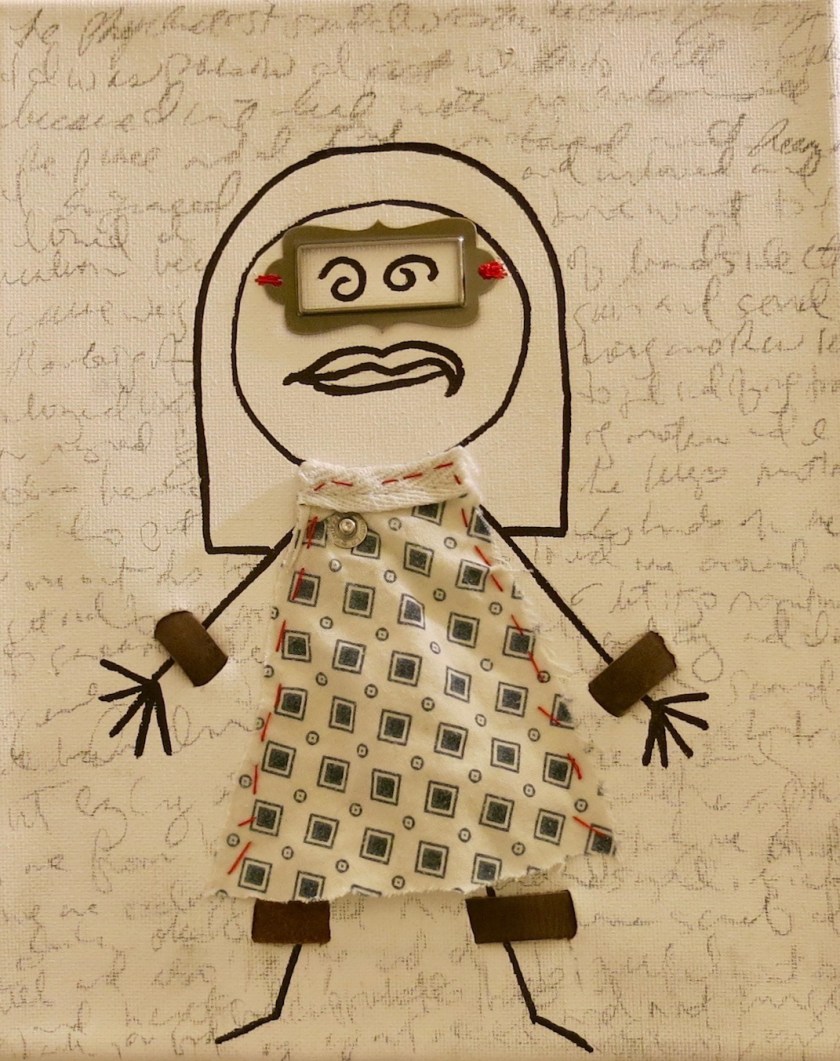
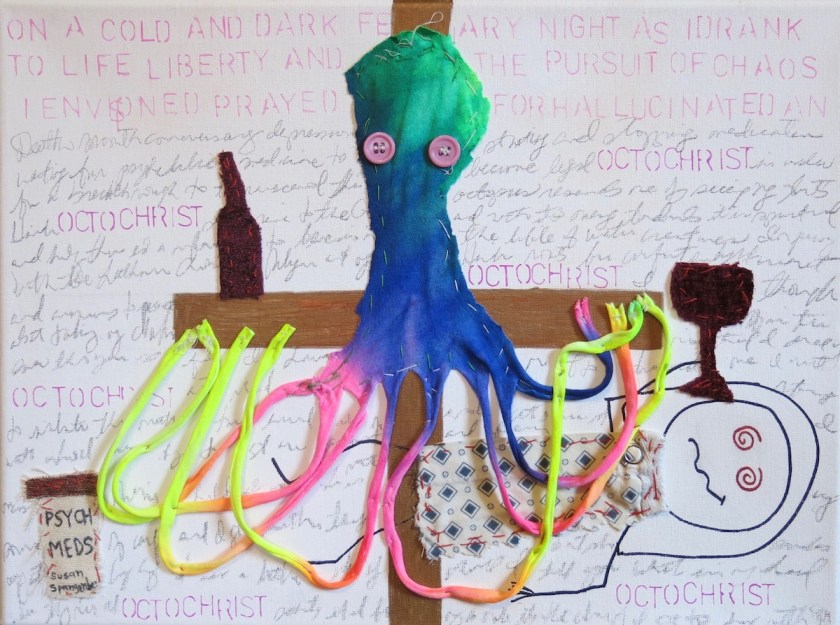
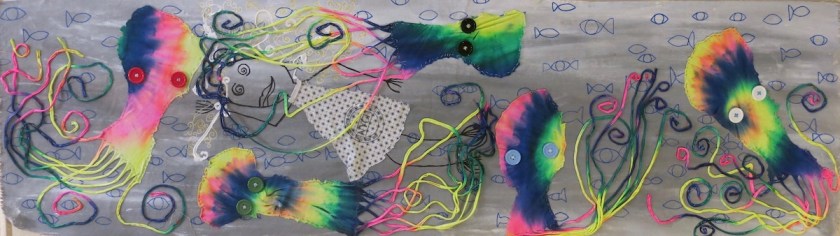
Coming from a severely dysfunctional family which led to group homes and institutionalization in her teenage years, Susan Spangenberg cut her outsider artist teeth at Creedmoor Psychiatric Center’s renown ‘Living Museum’ art rehabilitation program. She was on the vanguard of the ‘Girl Interrupted’ female asylum artist wave that has in twenty years become the new normal, yet Susan has maintained the raw essence of that genre imbued with a twenty-first century sensibility.
Girl In Restraints Looking Through The Seclusion Room Window Girl In Restraints Looking Throughpsychiatric hospital gown, leather, pencil, marker, metal on canvas 2019 (hand sewn) 8″ x 10″Octochrist pencil, text, marker, psychiatric hospital gown, fabric, buttons (hand sewn) on canvas 12″ x 16″Girl In Restraints Visits The Octopi Girl In Restraiacrylic, marker, psychiatric hospital gown, fabric, buttons on unstretched canvas 2021 (hand sewn) 72″ x 20″Girl In A Straitjacket pencil, marker, fabric on canvas (hand sewn) 8″ x 10″
Thank you to every artist who submitted artwork for this giant issue of Outsider Art Magazine. Get your art ready because in January 2021 we will be releasing a new call for art. In addition to visual art we will be accepting poetry, short (very short) stories, and interesting articles about artists and their creative journey.
Artists in this Issue
WILD TYPE
Robert Gorchov
Todd Brugman
John McCabe
Robbie Gallows
Dalia Goldberg
Stefan Pruteanu
Magdalena Sikora
Samantha Sadik
Sophie Jacobs
Paulina Klimek-Cornett
Abbott Philson
Nickolai Dostanko
Matthew Clarke
Szilard Juhasz
MRSN
Pracheta Banerjee
Baili Wise
Jimmy Gockel
Nicholas Teetelli
Karen Glykys
Robert Frankel
Charles McDowell
Arne Søvik Larsen
Nicole Sullivan
Hannah Bouchard
Xavier Yarto
Mark Pol Joyce Thornbug
Ian Hartley
Margarita Henriksson
Harrison Ernst
Homer Johnson
Tiantian Ma
Kayle A. Martinez
Rocio Garcia Montiel
Brooke Mathews
Brian Simons
Oliver Quinto
Romero Pasin
Thomas Sciacca
Dawn Rettew
Erik Aleksiewicz
NPrima/Natalia Proskuriakova
Jesus Diaz
Noah Velez
Andrew Stackpole
Gwen Hallford
Barbara Redondo
Anastasiia Kruglova
Jack Oliver
Ken Berman
Monica Tiulescu
Kitty Taylor
Dio D’Brutto
Lisa Castel
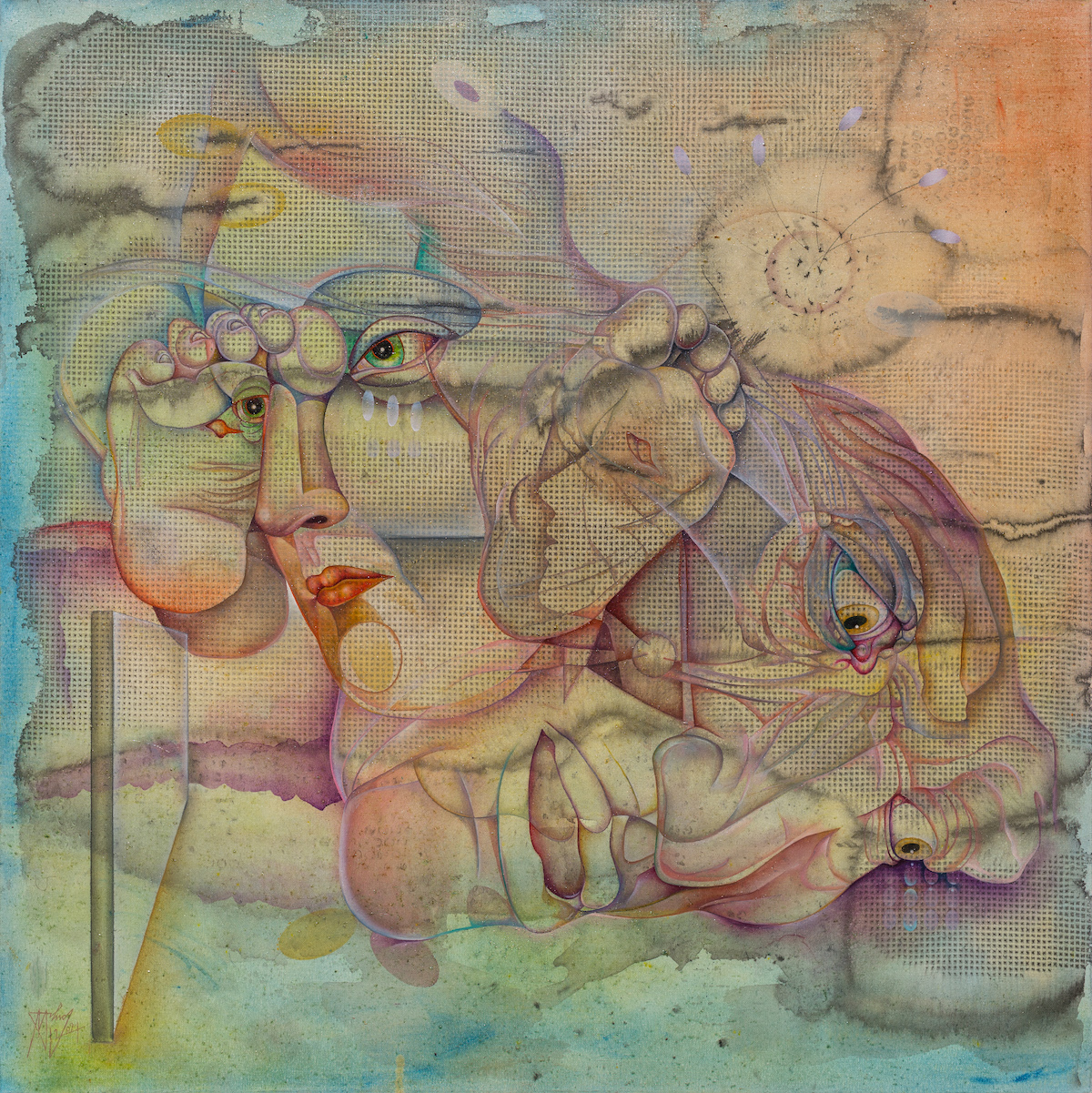
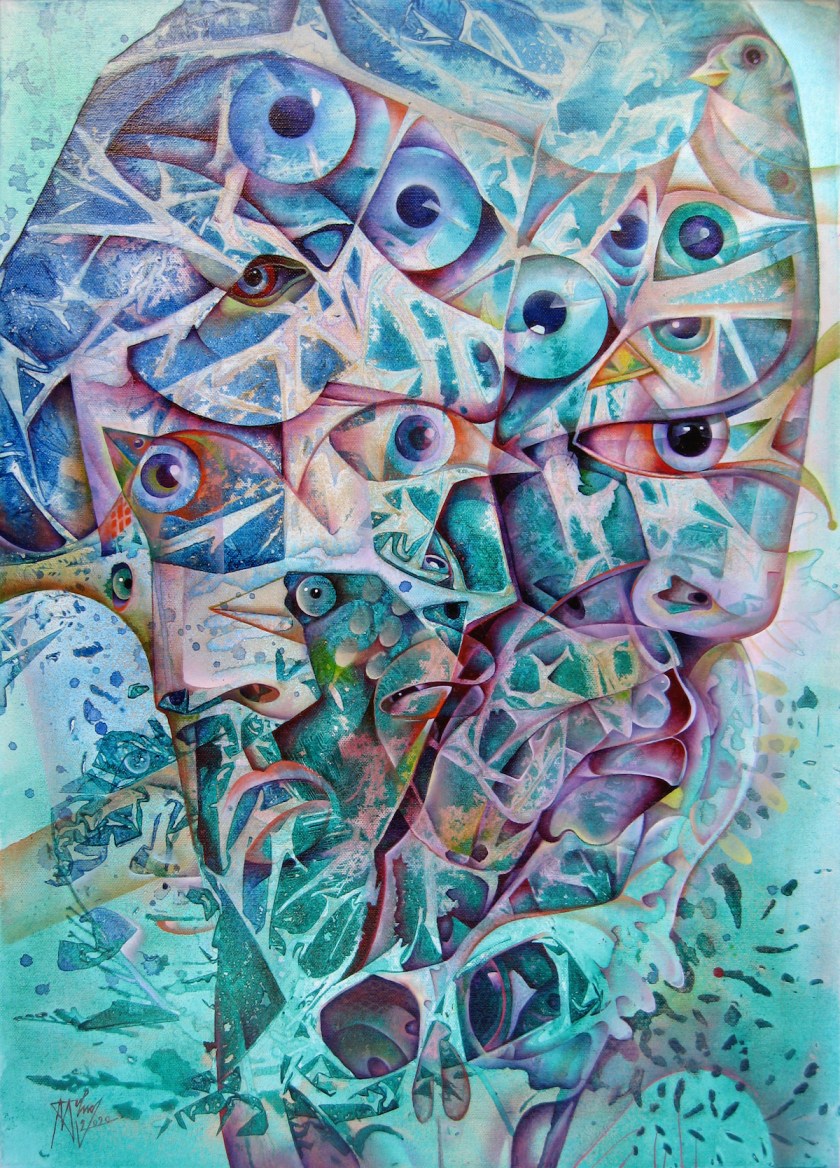
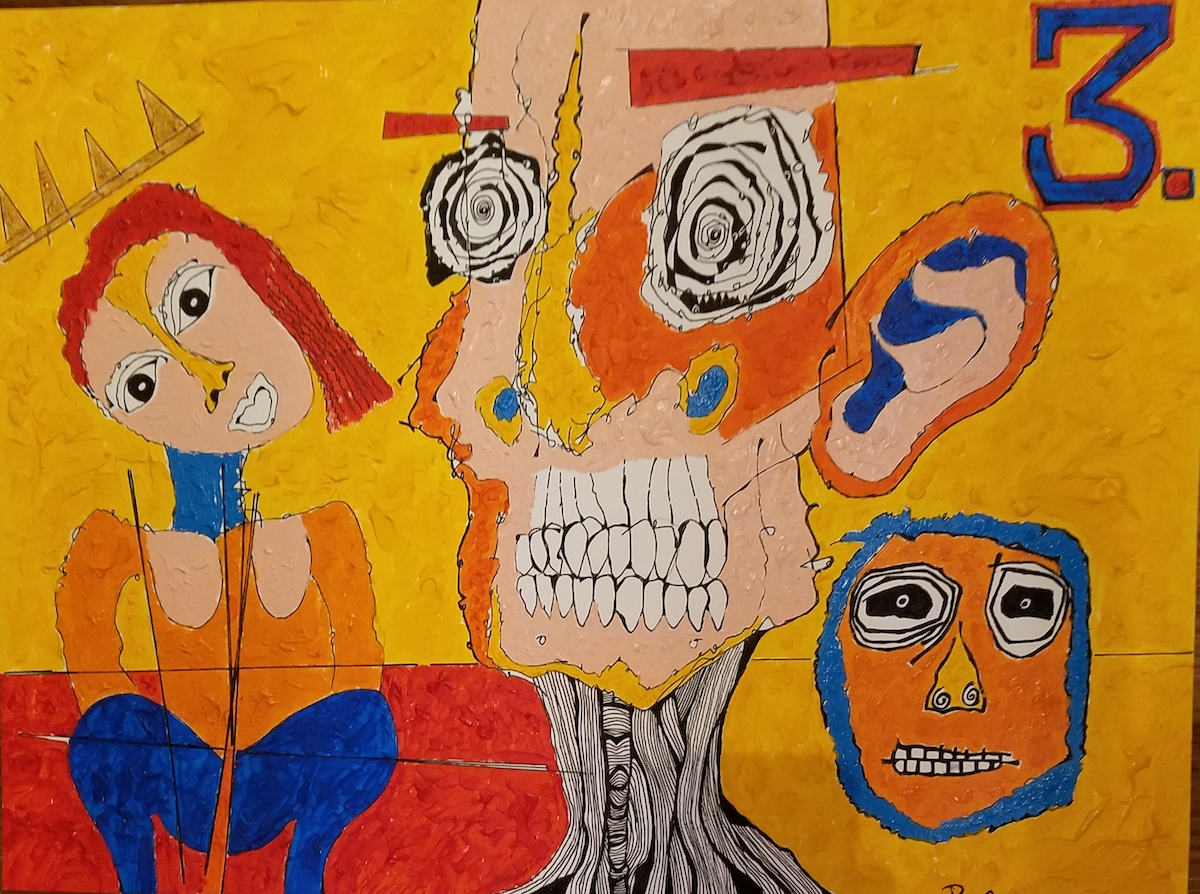
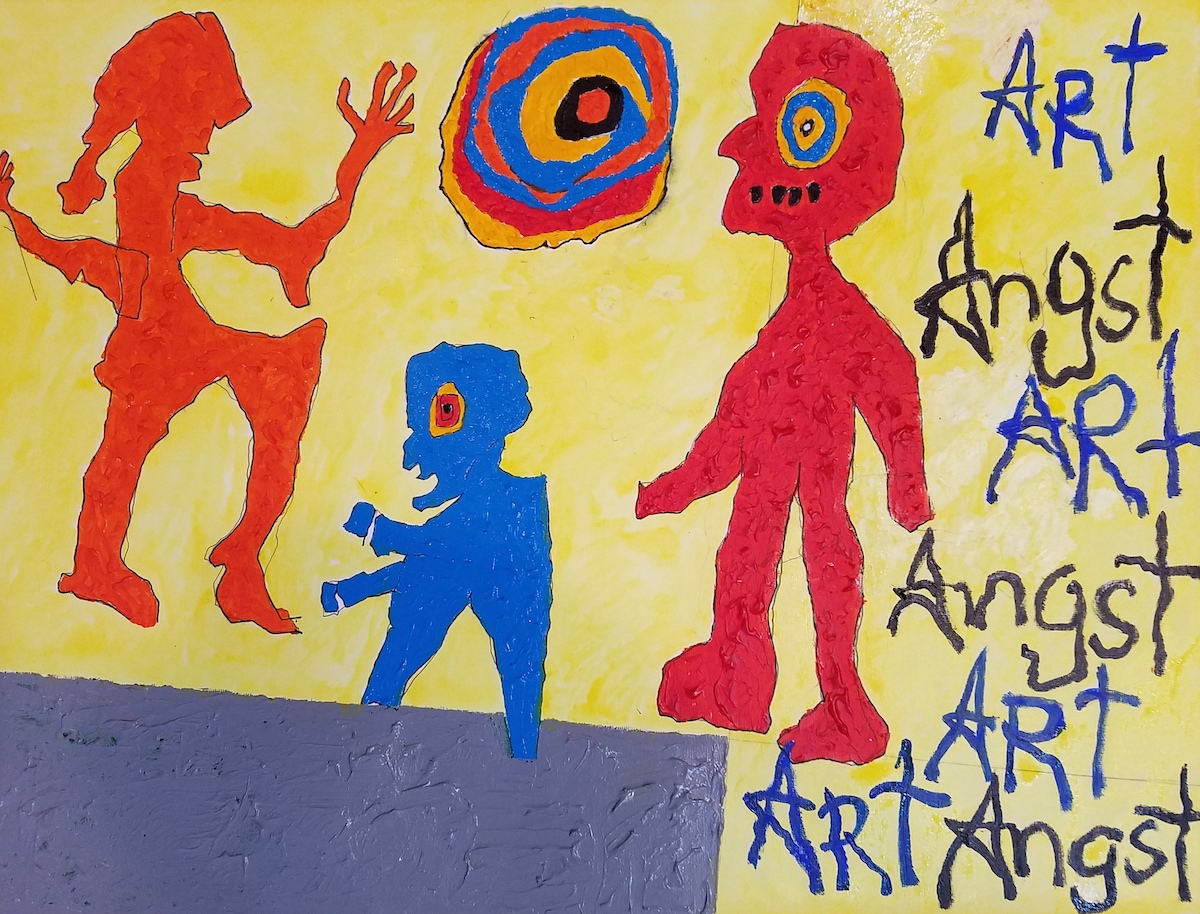
I’m a self-taught artist and have been drawing and painting for four decades. I’m interested in the process that creates a painting. Although it involves imagination, this process is affected by chance, so that when I begin a picture I have only a half-formed image of what the finished painting might look like. The completed piece only slightly resembles the image that I had in mind when I began it. I think of this as improvisation. Over the years that I’ve been painting, I’ve learned to trust the brush and the materials – to let them take the lead – and not to think too much about how it will end up . . . until I get to that end.
This is part of what makes painting interesting for me.
I’m a self-taught artist and have been drawing and painting for four decades. I’m interested in the process that creates a painting. Although it involves imagination, this process is affected by chance, so that when I begin a picture I have only a half-formed image of what the finished painting might look like. The completed piece only slightly resembles the image that I had in mind when I began it. I think of this as improvisation. Over the years that I’ve been painting, I’ve learned to trust the brush and the materials – to let them take the lead – and not to think too much about how it will end up . . . until I get to that end.
This is part of what makes painting interesting for me.




















 Outsider Art Magazine